 Upstream Pursuitsa field guide to running a profitable bookselling business
Insights for booksellers
Venture beyond the orange bars.
Seller Central gives you a wall of orange bars. It won’t tell you which books built them, which ones quietly cost you money every month they don’t sell, or what the pile you listed this week is actually worth. Connect your Amazon account and The Current will crunch your numbers for you — clarity on what happened, and our best guess at what’s next.
Reports are open · free for now
Connect your Amazon account and we’ll build your report from your own sales. The next step is Amazon’s own consent page, and you can disconnect anytime.
Field data, updated nightly 63 booksellers and 611,777 books already tracked. Every shelf that joins sharpens the benchmarks for everyone.
Four questions your shelf can answer.
You already know what you sold. These are the four that decide whether the next pile of books is worth buying — and every one of them is answerable from data you already have.
How fast do my books really sell?
Counted in days with a sale, not a sales rank that jumps around.
What do they really sell for?
A low, typical and high drawn from real sales — never hopeful list prices.
What’s left after Amazon’s fees?
Fees, storage, shipping in and the cost of the ones that never sold.
What should this month’s work pay me?
A number for the pile you just listed, set before you know how it turns out.
Unfold your map.
Every book you own sits somewhere on the same two axes: how often it sells, and what one copy pays once Amazon has taken its share. Plot your whole shelf on those axes and it stops being a list of titles. It becomes terrain — with regions you can name, borders you can see, and ground worth walking back to.
That map is the Ranger Atlas. It is built from your own sales, not an average of somebody else’s, and it tells you where your business actually is before it tells you where to go next.
Four regions, and your books live in all of them.
Ranger asks two questions of every book: how often does it sell, and what’s a typical payout after fees? The answers sort your whole shelf into four regions that behave nothing alike.
All of the picking, packing and postage, little of the profit. It keeps you busy.
The books your business actually runs on. Buy every one you find.
Slow and cheap. It costs shelf space every month to not sell.
Worth owning and worth waiting for, just not this month’s money.
And a fifth kind: the Outliers.
Some books sell too rarely to price with confidence, and pretending otherwise would be guessing. So instead of forcing them onto the map, Ranger grades them on their longer, five-year history. Some are lottery tickets. Some never sell.
A history of $40+ sales, five or more sales in five years, and a sales rank. About 1 in 5 sell within six months, but when one does it pays about $51.
Sold within the last five years, just rarely or cheaply. About 1 in 5 sell within six months, paying about $27 when they do.
No sale in five years. Fewer than 1 in 10 sell, which is worth knowing before you buy another one.
Across every seller so far
Follow every book our sellers listed, from the left, to the money it brought back within six months, on the right.
Four regions to start. The whole Atlas when you’re ready.
If you’re just getting going, the four regions are enough. They take thousands of books and give you four decisions. That’s the whole point of them — they simplify.
But if you want the juicy details, behold the Atlas: every square inch of your bookseller territory, mapped. Every speed band against every payout tier, every square coloured by the region it belongs to, with the $2.50 payout floor drawn straight through it. Nothing is averaged away. You can see exactly which squares your business lives in.
The Outliers sit in their own column past the edge of the map. They keep their speed row — we know how often they move — but there is no payout column honest enough to put them in, so they get one of their own rather than being quietly filed under cheap or dear. Their sales and sell-through are real figures; only the valuation is left blank.
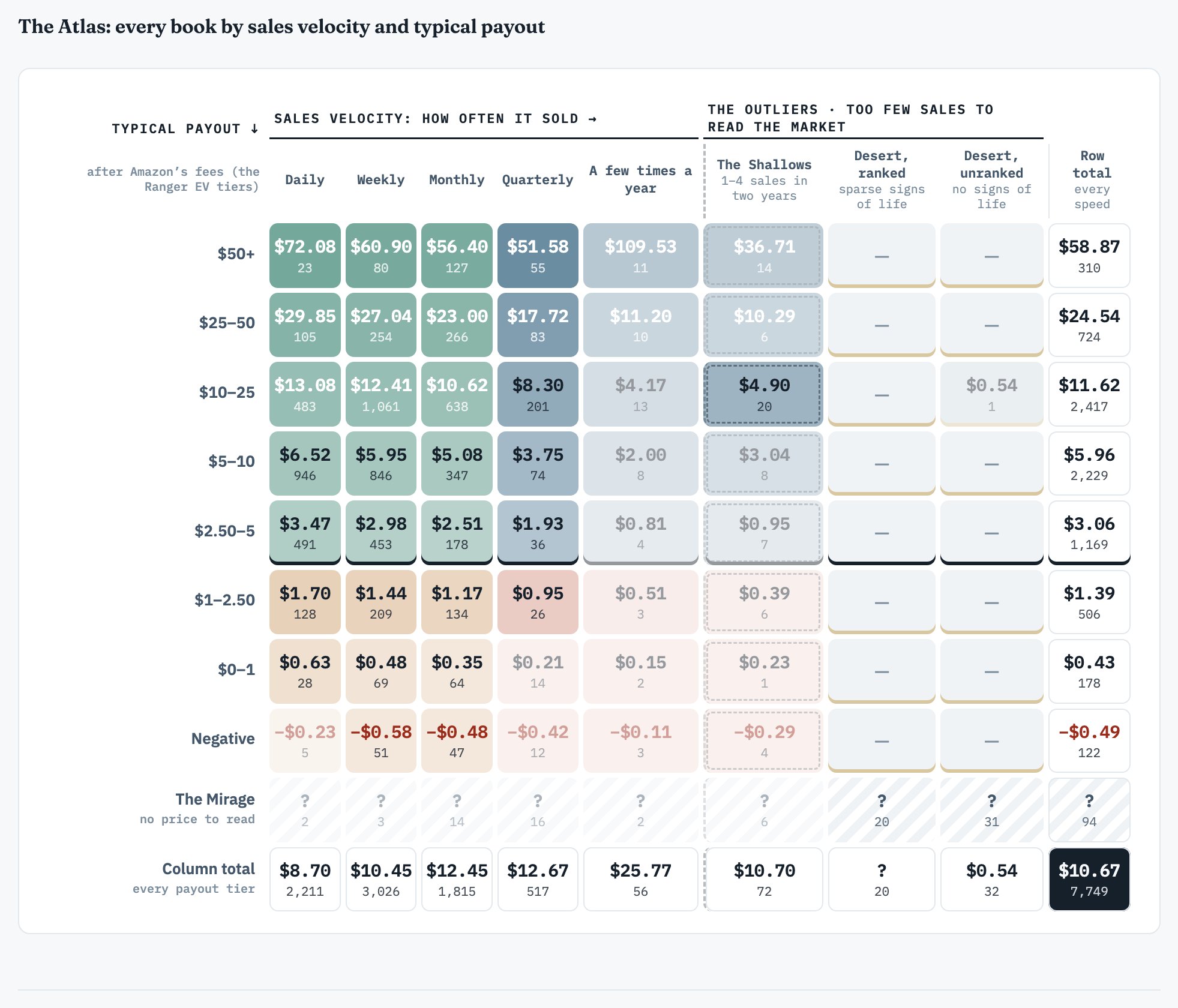
What the Atlas shows you
Four readings, all from your own books.
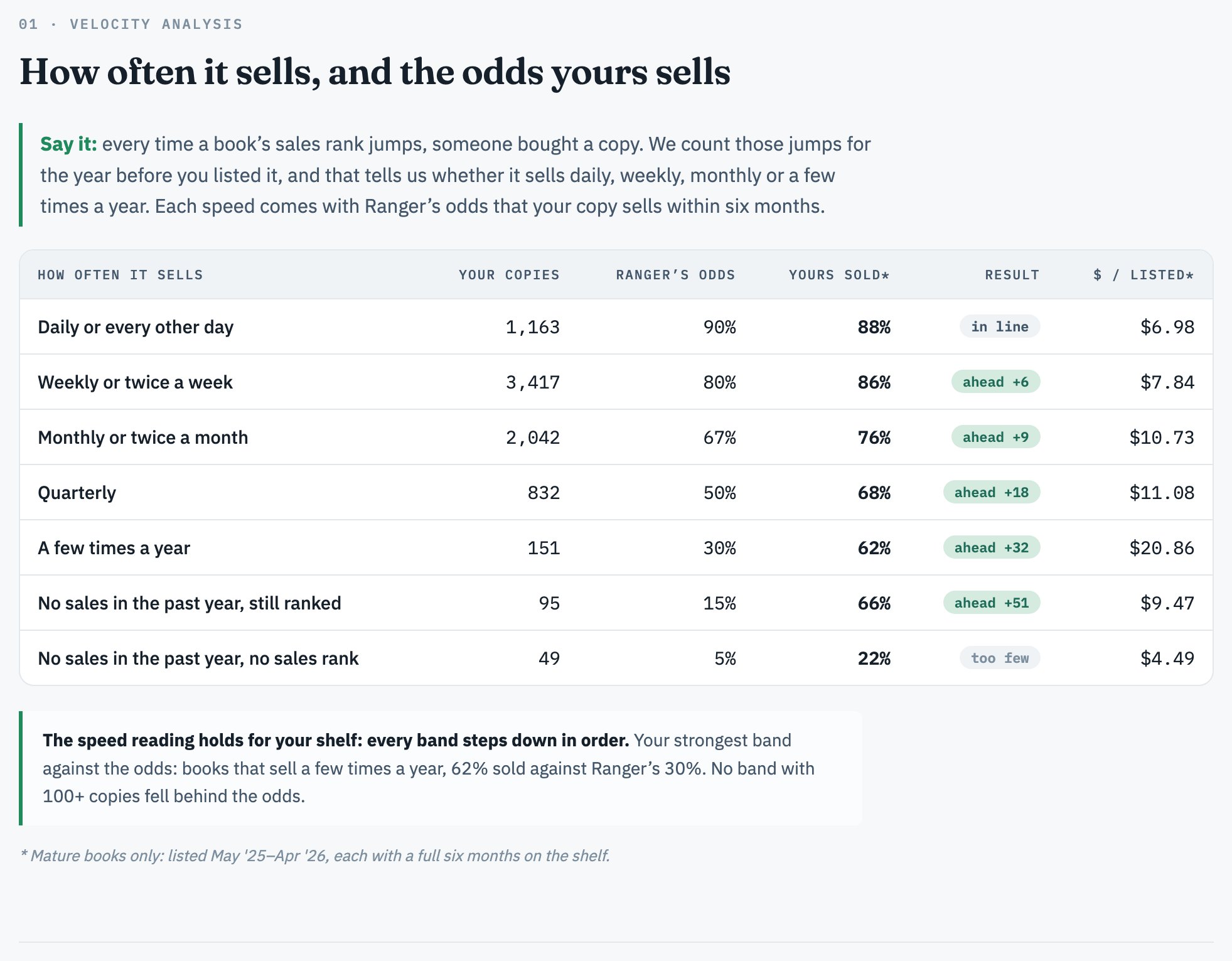
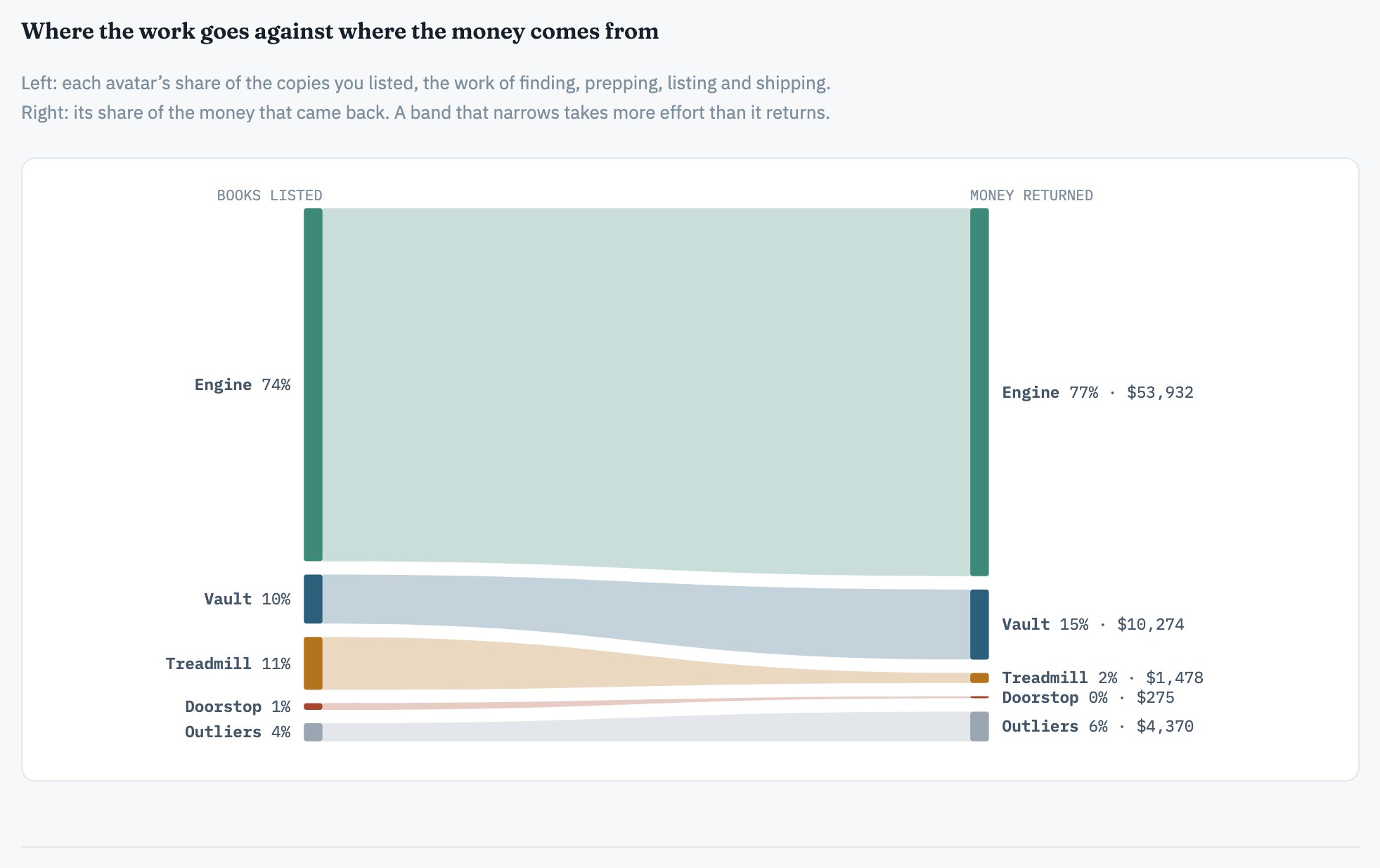
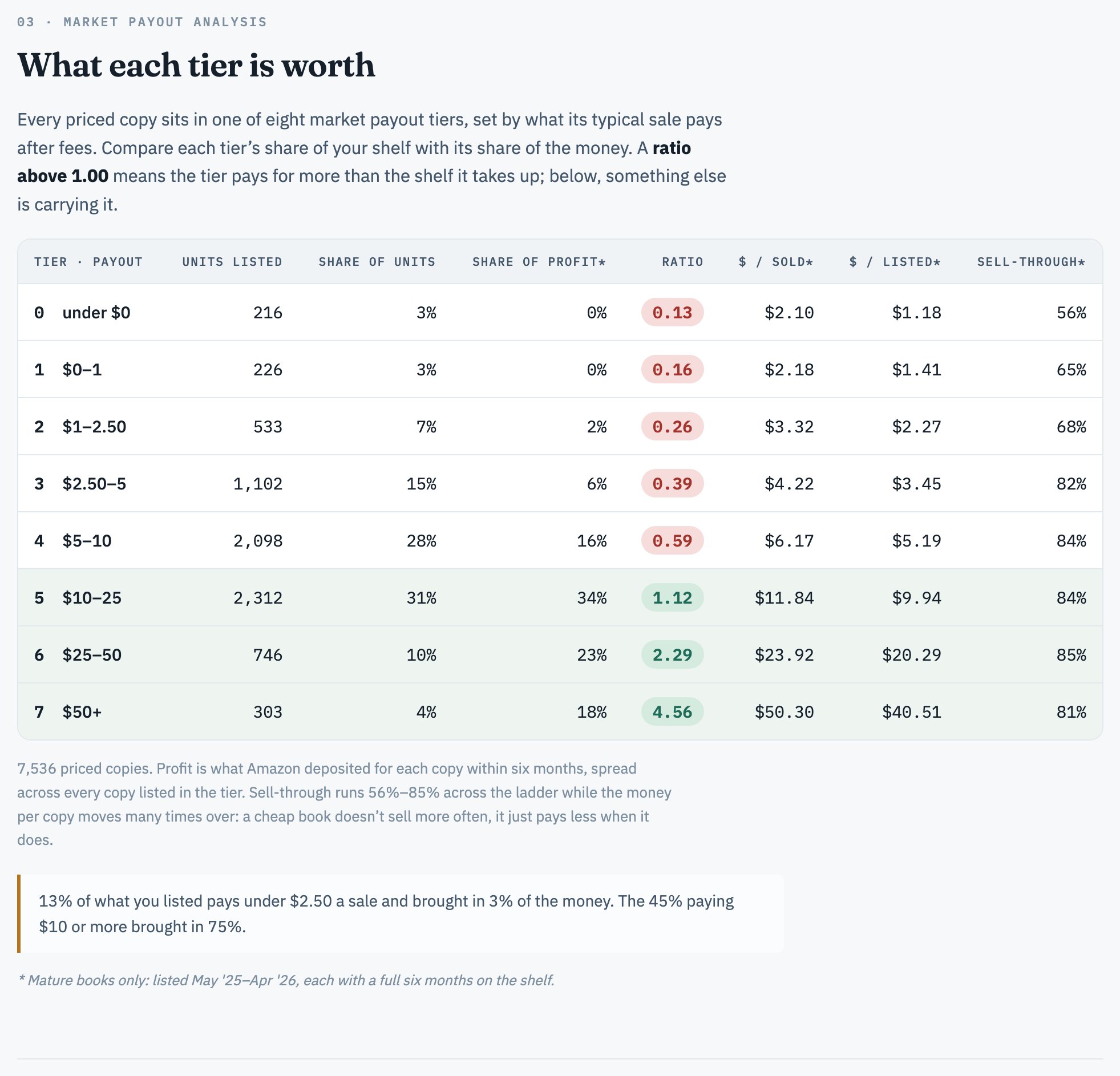
Every plate above is from one real FBA bookseller’s report, shown without their name.
How Ranger reads every book.
The same method Ranger uses on each book you scan, applied to everything you’ve listed over the last 18 months.
Sales Velocity
How often the title really sells, counted in days with a sale, not a rank that jumps around.
Market Price
What it really sells for: a conservative low, typical and high value from real sales, never hopeful list prices.
Market Payout
Market Payout, after Amazon’s fees: what one sale actually deposits, sorted into eight tiers.
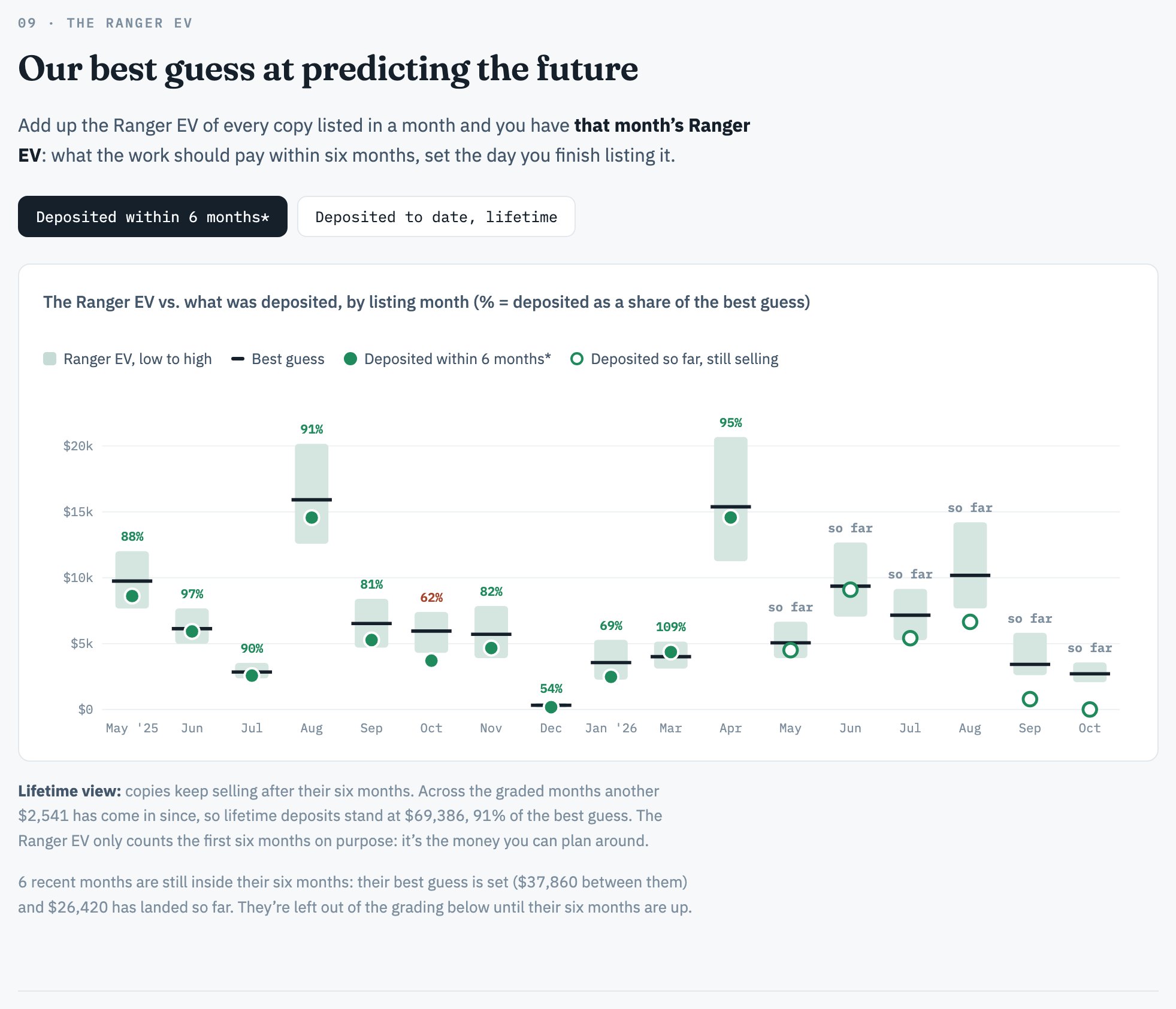
Ranger EV
The expected value within six months: how much cash you can expect Amazon to deposit from this pile of books.
Market Payout × odds of selling in 6 months = Ranger EV
Why is it called “Ranger”?
A guide on your path
Just like a park ranger helps you get the best experience out of a national park, our goal is to guide you along your path as an Amazon seller: where to go, what to watch for, and where the good ground is.
A look into the past to see what books really sell for
Ranger looks back at real sales and distills every book down to the range of prices where it typically sells, so you know whether today’s market price is in range or out of range.
Want a guide on your path?
Tell us where you are and what you’d like help with, and we’ll get back to you.
Know your shelf.
Reports are open, and free for now. Connect your Amazon account to see yours.
The next step is Amazon’s own consent page, and you can disconnect anytime.